Uncategorized

When Plans Go Awry

The Bais Yaakov Project Team is a continuously-growing group of people associated with Bais Yaakov in many ways. Most of us are graduates of a Bais Yaakov school, spanning multiple schools and multiple decades. Some members on the team – Naomi Seidman and Leslie Ginsparg Klein most notably – are experts on Bais Yaakov after years of research and publishing on the topic. Some of us, though, are only tangential experts.

Take me, for example. My primary area of research is not Bais Yaakov. My PhD work is on ideologies of childhood and education as represented in literature. I write about this topic as it relates to multiple time periods and cultures: medieval Britain; medieval Ashkenaz; contemporary children’s historical fiction; and, most notably as my dissertation, contemporary haredi children’s literature. I became involved with the Bais Yaakov Project after connecting with Naomi and talking about our shared passions of understanding histories of education and our shared concern over the lack of available sources documenting haredi education.

Shira Schwartz

We also had a mutual connection, Shira Schwartz, a PhD candidate at the University of Michigan, Ann Arbor, writing about “Yeshiva Quirls: A Textual Ethnography of Jewish Gender, Sex and Reproduction.”

Shira and I had once dreamed about someday, when we weren’t grad students trying to get our dissertations done, creating an online repository of documents from Bais Yaakov schools and yeshivas so that others who work on these subjects after us could have an easier time. When Naomi talked about all the material she had collected from multiple sources as she worked on her book, it was the perfect shidduch – I had already been thinking about what an online repository could look like, and we immediately got started on building a website.

For fields like ours, where the focus is on attitudes and approaches to education, it’s important not to rely only on sources like official school reports or official school publications. Sources like student publications, class notes, and teachers’ lesson plans are equally as important. They demonstrate what happened in schools in great detail, while official documents tend to provide a much broader picture.

Of course, these sources of detailed and minute evidence are also among the first to disappear. As I wrote about previously, ephemera like class notes can show us how teachers conducted their lessons and how students received them.

For today’s peek into the archives, I want to highlight what we can glean about the structure and ideology of schools from a lesson plan book. The pages I’m focusing on today comes from my own lesson plan book, from my years teaching Grade 8 English Language Arts in Bais Yaakov of Boro Park (2007-2009).

The title page of a lesson plan book.

For two years after I graduated from Yavne Seminary in Cleveland, I taught alongside my own teachers in the institution where I had once been a student. Each week, I submitted a page to Miss Carmie Homburger, who had been my principal when I was in 8th grade, outlining what I planned to teach that week. My usual weekly plan included literature on Mondays and Tuesdays; grammar on Wednesdays; and writing on Thursdays. 

The page from my lesson plan book showing the week of March 24-27.

When I extricated my lesson plan book from my boxes of old papers in order to scan and upload it for the Bais Yaakov Project website, I was struck by the way I often updated the lesson plans to keep track of what actually happened in class.

As all teachers know, what we plan often isn’t what ends up happening in class. But the paper documentation doesn’t always reflect the reality of what transpired. For the week of March 24-27 in my lesson plan book, though, I took care to record the “real” lesson.

The carbon-generated plan, the one that I handed in to my supervisor, indicates a focus on Flowers for Algernon on Monday and Tuesday; grammar on Wednesday; and writing on Thursday. The ink column, titled “REAL,” shows what actually happened in class, and the reason the lesson diverged from what I had planned.

On Tuesday, one of my classes did not meet because they had a gym period instead. And on Thursday, another class had a gym period. Now, since I’m working with my own documents here, I can draw on my memories to fill in the blanks.

In New York State, schools are mandated to provide physical education. Bais Yaakov of Boro Park, since it receives government funds for programs like transportation, textbooks, and special education, is bound by those laws and regulations. But the Bais Yaakov school day would need to be lengthened even more, past its 4pm dismissal time, if Phys Ed were a class scheduled regularly like any other.

Instead, the school crafted a system where each class of students would miss one afternoon period a week for “gym,” rotating among the four periods so each teacher would give up one lesson a week per class.

And I had forgotten to account for the two classes who would be missing my period for the week of March 24-27.

The page from my lesson plan book showing the week of October 29-November 1.

Accounting for the change in schedule involved a simple shifting around of plans. Usually, the school would schedule all three of my classes for gym the same week, so that I could count on all three classes missing one day. That would make my rescheduling of lesson plans easier.

Of course, even without the occasional hitch in schedule – accounting for things like assemblies and gym – classes all moved at different paces, and you can see that difference in the more regular lesson plans as well.

When we work with documents that are older than mine, and whose creators are no longer able to provide context via their memories and oral accounts, we’re left to guess at what happened in each document. And the more documentation we have, the better our chances of guessing right become!

Later this week, we’ll be uploading scans of a curriculum plan from a school in Toronto. As I hope this peek into the archives makes clear, planbooks and curricula indicate an ideal, but plans often go awry. Looking at the original plan and the ultimate outcome together helps us get a more complete picture of what Bais Yaakov schools look like and value.

headshot of dainy bernstein

Dainy Bernstein is a PhD Candidate at the CUNY Graduate Center, finishing their dissertation, “Chanoch La’Na’ar: American Haredi Children’s Literature and Education, 1980-2000.” They teach composition and literature at Lehman College. 

Why Didn’t Sarah Schenirer Want Her Photo Published?

The famous drawing of Sarah Schenirer

It’s well known to every Bais Yaakov girl that Sarah Schenirer did not want her photograph published. When I began my research almost ten years ago, there was still no widely available photo of her. Instead, what circulated was a line drawing that had been distributed by Bais Yaakov in the interwar period, and was included in the frontispiece of her 1933 Gizamelte shriftn (Collected Writings).

It was only in 2007 that the now-familiar photo (below) was published in SŚwiat przed katastrofą. Żydzi krakowscy w dwudziestoleciu międzywojennym (A World Before a Catastrophe: Krakow’s Jews Between the Wars), edited by Jan M. Malecki. The photo surfaced online in 2008 in a blog post on the Seforim Blog by Dr. Shnayer Leiman of YU.

The title of Pearl Benisch’s biography of Schenirer, Carry Me in Your Heart, refers to what Schenirer would say when asked for a photo from one of her beloved students: her resistance to being photographed was softened by her words, which made palpable the love and closeness that tied founder to followers, even in the absence of a photo.

Sarah Schenirer’s resistance to being photographed is of a piece with other aspects of how she is described in the movement, including her “shunning the spotlight” at the grand ceremony in 1927 to lay the cornerstone of the Krakow Seminary.

Her piety and modesty are sufficient to explain the absence of a photo of a woman so revered, whose photo would be cherished by thousands.

A postcard sent from the professionalization course at Rabka, 1928.

That many Orthodox publications, and even Bais Yaakov websites, now refrain from publishing photos of women and girls, lends support to the supposition that Schenirer held back her photo because of her commitment to feminine modesty.

That may well be true. But there are a number of other aspects of Sarah Schenirer’s biography that complicate this picture.

The presence of dozens of photos of women on this website, and in interwar Bais Yaakov publications, stands as evidence that Bais Yaakov had no conception of the publication of women’s photographs as immodest.

Many photographs were professionally done, and photography was clearly an important part of Bais Yaakov culture.

Moreover, the notion that Sarah Schenirer “shunned the spotlight” at the 1927 ceremony is qualified by contemporary newspaper reports, which simply describe the event as sexually segregated in the audience, with only men on the dais. This, too, was simply normal Agudah practice for public events. It makes sense to describe Sarah Schenirer as modestly refusing an invitation to sit on the dais only if such an invitation had been offered. But there is no reason to think it was.

The question might be more easily resolved by reading Sarah Schenirer’s own words in relation to a request for a photograph. I have found only one such direct quote, in a 1933 article in the Bais Yaakov Ruf, the periodical that served the Lithuanian branch of the movement. The anonymous article quotes a letter from Sarah Schenirer responding to the newspaper’s request:

In regard to your request for a photo to publish in your newspaper, I absolutely cannot do that for you, and further insist that my photograph will not, God forbid, appear in your newspaper. I am terribly against that, but unfortunately my photo has been published throughout the land without my consent, and my anguish over that has been indescribable.

The article in the Bais Yaakov Ruf explaining that they had asked for a photograph from Sarah Schenirer, and recording her response.

The report continues by noting that these words can themselves provide a truly beautiful portrait of Frau Schenirer, a portrait that reflects her truly Jewish modesty.

This report seems to confirm the understanding of Sarah Schenirer’s reluctance to have her photo published as a form of Jewish piety, or at least shows us that this reluctance was understood in this way during her own lifetime. But the words, an apparent direct quotation from Frau Schenirer, do not spell out the reasons for her determination to keep her photo from publication.

Moreover, they express something of her strong will—she speaks of her rights, of consent, and makes her absolute refusal clear without attempting to soften her words.

Not modesty but rather fierce determination and self-protection are what come through in these words.

Might there have been another explanation?
Sarah Schenirer’s application for an identification card [National Archives Kraków, call number: STGKR 990].

Sarah Schenirer’s diary speaks of her sense of herself as unattractive, and records her pain (during her difficult first marriage) at feeling that she could hardly expect her husband’s love, given her lack of beauty. In this context, it may be relevant that the article that records her refusal to have her photo published also gets her age wrong: the article begins by stating that the newspaper sought the photograph in the context of celebrating her sixtieth birthday—in fact, Schenirer turned not sixty but fifty in July 1933.

Are we getting the picture straight, in subsuming all these complicated social and psychological factors under the rubric of “modesty”?

We now have a photo of Sarah Schenirer, one she would have fought to keep away from prying eyes. What are the ethics of showing it?

My own discomfort around these questions have led me to include the photo only in the context of the application form in which it appears, and as small as possible—admittedly a partial salve.

The face that appears on the form is less “feminine,” and more “modern” in some hard-to-describe fashion than the drawing.

Does it tell us something about Sarah Schenirer that the drawing did not?

Does the drawing tell us something about how Sarah Schenirer was idealized, and obscured, by the movement she founded?

Does some truth lie between the drawing and the photo?

What emerges from these photos and words, once we allow them to expand beyond the simple and comforting idea of Schenirer’s as the perfect image of a Jewish woman’s tsnies?  

A previous version of this post mis-identified the first date of appearance of Sarah Schenirer’s photo.
Many thanks to Fred MacDowell for pointing out our error.

Naomi Seidman is the Chancellor Jackman Professor of the Arts in the Department for the Study of Religion at the University of Toronto and a 2016 Guggenheim Fellow; her 2019 book, Sarah Schenirer and the Bais Yaakov Movement: A Revolution in the Name of Tradition, explores the history of the movement in the interwar period.

Singing the Bais Yaakov Song on a Lakewood Farm

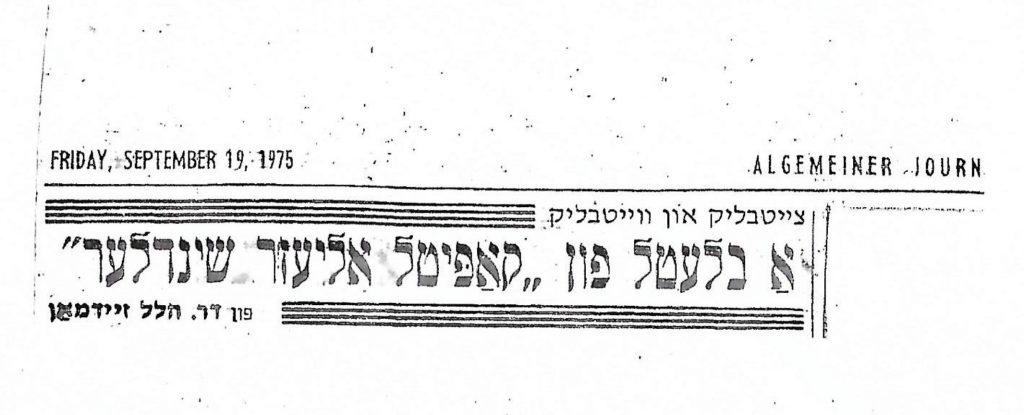
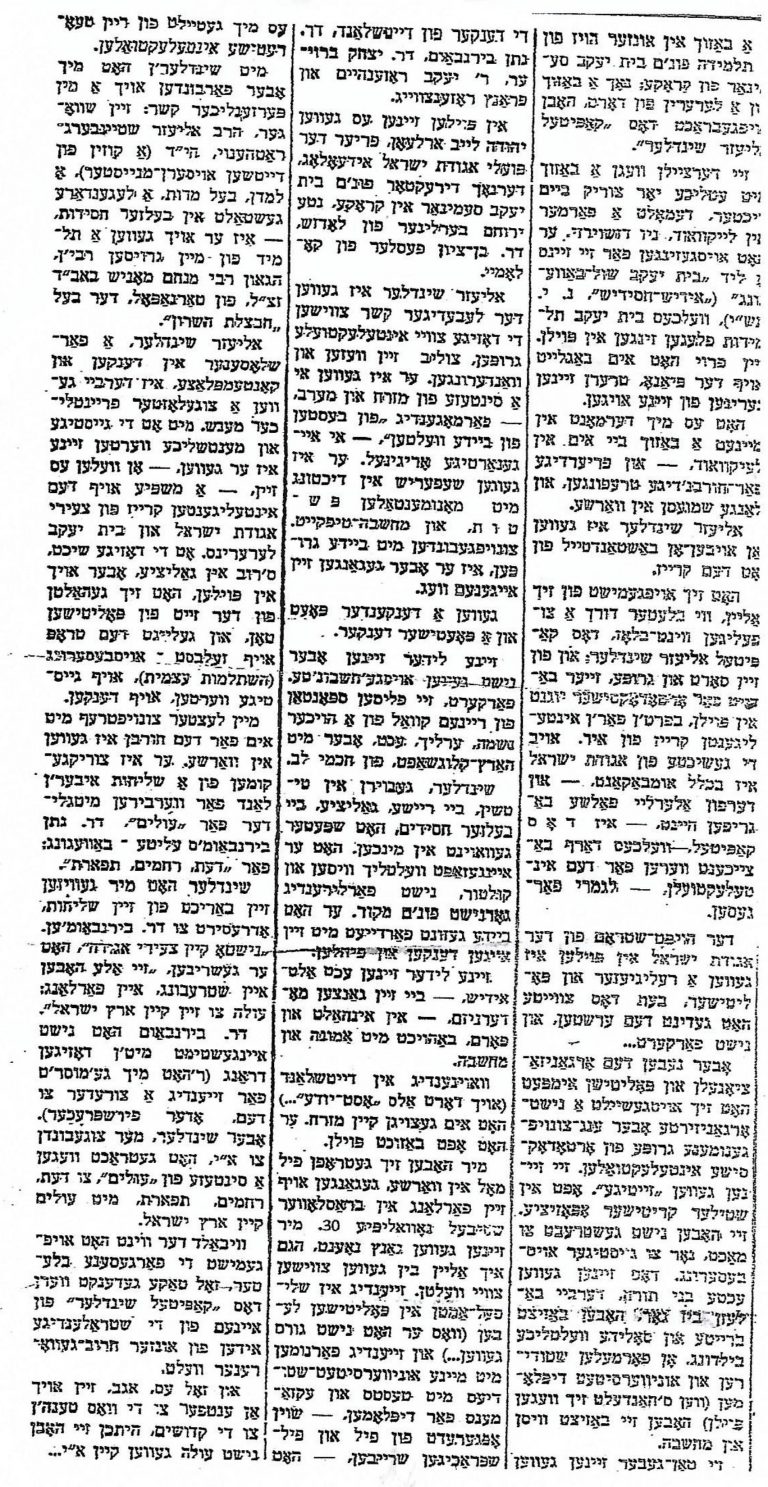
In September 1975, my father, Hillel Seidman, wrote an article in the Algemeiner Journal called “Pages from ‘the Eliezer Schindler Affair.’”

It starts:

A visit to our house by a student of the Bais Yaakov Seminary in Krakow; another visit by a teacher from there brought back to mind the whole Eliezer Schindler affair. The two women tell the story of visiting the poet, who was then a farmer in Lakewood, New Jersey. He sang for them his Bais Yaakov song, which Bais Yaakov girls in Poland used to sing. His wife accompanied him on the piano, tears streaming down both their faces.

That reminded me of my own visit to Lakewood, and earlier times we met before the Holocaust times, talking for hours in Warsaw.

The song Schindler sang is the first one in the Bais Yaakov songbook I found so many years ago in the YIVO archive, the catchiest one, and the only one that is still sometimes remembered. Dainy Bernstein supplied a chorus, absent from the songbook, that they had heard in their family.

Recording by Dainy Bernstein supplying the chorus missing from the songbook [with an incorrect word in the verse]:

I had long seen and noticed that the song was written by Eliezer Schindler, and known, too, that he had been a farmer in New Jersey. But I had not heard the story that my father relates here, that Schindler and his wife sang the song for a visiting teacher and graduate of the Krakow Seminary, and cried.

This I learned from the article, which Miriam Oles, Schindler’s granddaughter, emailed to me this week, with the question of whether Hillel Seidman was a relation.

The text of the original article.
Sali (Hojda) Schindler and Eliezer Schindler on their Lakewood Farm
  

Beyond the moving picture of the song, the detail that catches me is the Lakewood farm. Why a farm? And why in Lakewood?

My father doesn’t exactly say why Schindler chose to live outside the centers of Orthodox life in America at the time, but he does paint a picture that helps us guess at an explanation. Schindler, the poet and farmer, was a living bridge between Germany and Poland, combining an artist’s life and deep connections to his Hasidic past.

Schindler traveled to Poland to recruit Agudah youth to Nathan Birnbaum’s utopian project, Olim (The Ascenders), which called for Jews to return to working the land, to live simply and collectively, and to devote themselves to spiritual pursuits. The men differed, my father says, on whether this new way of life should establish itself in the Land of Israel or rather transform life in the diaspora. Schindler seems to have fulfilled the agricultural part of this vision, without, as far as I can tell, the collective around him that Olim envisioned.

Was Olim a failure? Was Schindler its last or only member?

Schindler was always a rare bird, but in Europe he was also part of the Agudah.  Writing in 1975, when an Orthodox Jewish poet was harder to find, my father felt the need to explain to his Orthodox readers that Agudath Israel in Poland was not just—as they assumed—a political organization, guided by a group of religious authorities. Alongside this organization was a tightly connected non-organization of intellectuals, writers, and dreamers.

My father writes about these intellectuals:

They were permanently marginal. Often in silently critical opposition. They had no desire for power, only for spiritual development. They were truly devoted to the Torah, but at the same time they had a solid and comprehensive secular education. Without formal studies or a university degree (at least in Poland), they possessed both knowledge and thought.

Agudah continued – and continues now – as a political organization answering to the rabbinical authorities, to Da’as Torah. But where were and are the marginal counterparts that also formed part of the interwar Agudah world, the intellectuals and poets and dreamers? Did Schindler live on a farm “in silently critical opposition” to the yeshiva nearby?

It was no surprise that the intellectuals my father described, who inhabited the margins of the Agudah, are also the ones most likely to show up in the history of Bais Yaakov.

Did Schindler write a love song to Bais Yaakov because he identified with the marginality of girls and women in a world dominated by rabbis and activists? Did Bais Yaakov represent a more open field for cultural experimentation than was available in the male sphere?

My father says that Schindler was particularly beloved as a poet in Bais Yaakov. Whatever was going on at the yeshiva, somewhere out of town Bais Yaakov girls were making pilgrimages to the poet and farmer, to hear him sing the song he had written for them.

Naomi Seidman is the Chancellor Jackman Professor of the Arts in the Department for the Study of Religion at the University of Toronto and a 2016 Guggenheim Fellow; her 2019 book, Sarah Schenirer and the Bais Yaakov Movement: A Revolution in the Name of Tradition, explores the history of the movement in the interwar period.

When Bais Yaakov Girls Commissioned a Sefer Torah

The fact that Bais Yaakov resists any suggestions that it is a feminist phenomenon does not mean that teachers do not have to contend with students pressing to know, for instance, why girls don’t dance with the Torah on Simhas Torah, or even touch it. I was one of those students. When I asked Rebbetzin Bruriah why we couldn’t dance with a Torah on Simchas Torah, when we were spending all our time learning Torah, she responded to by saying, “I do dance, I just dance in my seat.” Torah scrolls just aren’t for girls, however better than their brothers they may be when it comes to knowing it (as opposed to the Talmud, which is the major curriculum in yeshivas). Certainly I never saw a Torah scroll at a Bais Yaakov school or camp. Are there some who have one, not for the men but for the girls and women?

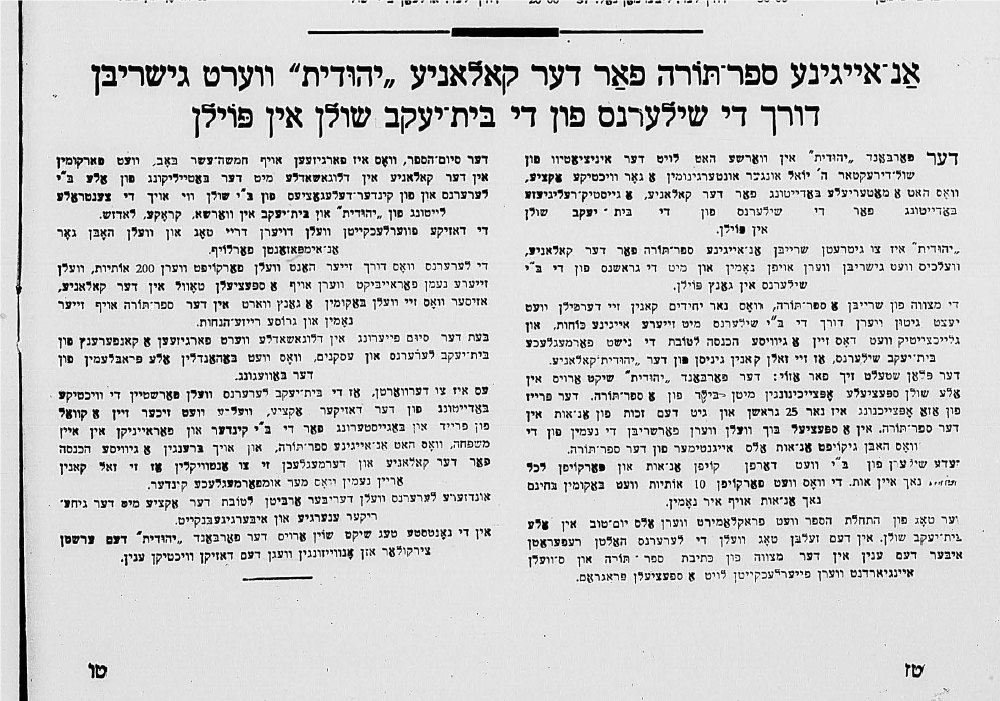
So I was pretty surprised to read a report in a 1933 issue of the Bais Yaakov Journal about a girls’ camp commissioning a Torah scroll: 

The Yehudis Camp has its own Sefer Torah written with the support of the students of the Polish Bais Yaakov schools

The Yehudis Association of Warsaw, through the initiative of the school director Mr. Yoel Unger, has undertaken an important initiative, with a material significance for their camp and a spiritual-religious significance for the students of the Bais Yaakov schools in Poland. 

Yehudis has undertaken to have its own Sefer Torah written for their summer camp, which will be written in the name of and with the pennies of the Bais Yaakov students throughout Poland.

The mitzvah of writing a Sefer Torah, which only a few individuals have fulfilled, will now be fulfilled by the Bais Yaakov students with their own energies, and at the same time this will raise funds for scholarships for less well-off students to attend the Yehudis Camp.

The original article in Yiddish.

The article goes on to describe the efforts to raise funds for the Sefer Torah and for scholarships to the camp throughout Poland, with girls buying letters and schools taking the opportunity to teach the laws of the Torah scribe, and the mechanisms of inscribing a Torah. Teachers who raised funds for 200 letters would have their names inscribed on a special plaque in the camp. The installation of the Torah scroll, the report continues, took place beginning on Tu Be’Av in the camp, with festivities, a conference, and other programs going on for three days. As it concludes, the act of collectively inscribing a Bais Yaakov Sefer Torah would certainly create a groundswell of joy and enthusiasm for Bais Yaakov girls, “uniting them in one family, which has one Sefer Torah.” 

This is a remarkable story for many reasons, and the report does not answer all my questions.

Did the girls not only fund the Sefer Torah and follow its progress with a sense of collective ownership and pride, but also touch it, hold it, carry it to the Ark?

Was there an Ark?

Did the girls dance?


A rare find of old ephemera. Israel Mizrahi, a dealer and seller of used and antique books, found this flyer among a shipment of books he acquired recently. No more information is available as of yet about the date, events, or people associated with the flyer. The flyer reads:

ATTENTION! 
BNOS MEMBERS
THE BAI IS SPONSORING 
מנין לבנות 
EVERY שבת מברכים AT 9:30 AT THE 
AGUDAH BUILDING 
436 CROWN STREET (UPSTAIRS) 
BET KINGSTON AVE & BROOKLYN AV 
FOR 3rd GRADERS & UP 
HIGH SCHOOL INCLUDED 
REFRESHMENTS WILL BE SERVED 
HOPE TO SEE YOU א’ה 
THIS שבת

While this flyer is unrelated to the article about the sefer Torah, it leaves us with many similar questions: 

What did this minyan look like?

Did girls or women lein from the Torah?

Was there a female ba’alas tefilah or ba’alas koreh in an Agudah building?

Naomi Seidman is the Chancellor Jackman Professor of the Arts in the Department for the Study of Religion at the University of Toronto and a 2016 Guggenheim Fellow; her 2019 book, Sarah Schenirer and the Bais Yaakov Movement: A Revolution in the Name of Tradition, explores the history of the movement in the interwar period.

Ephemeral Treasures

After a summer hiatus during which we strategized and brainstormed (and wrote grant applications), we’re back with more material from the archives! 

This week, I’m highlighting some materials donated by individuals from personal archives: class notes.

The first page of a bundle of notes from a high school class.

Class notes are the kind of thing that usually don’t survive more than a generation or two, if they even survive past the beginning of the summer. (Don’t lie, have you ever tossed a year’s worth of class notes into the trash with a great sense of satisfaction?)

Thankfully, some of us are hoarders and keep every scrap of paper we’ve collected through the years. Having access to these class notes is a tremendous benefit to scholars and researchers of Bais Yaakov, since it allows us to take a deeper look into what was taught in the classroom.

We can of course use resources like Torah Umesorah to find out what materials teachers use, and we sometimes have access to school curricula.

But how do we know what classroom instruction actually looked like? How can we know if the lessons in official documentation were delivered that way, or if they were altered by each teacher to fit her style and method? How can we know how the lessons were received by students?

That’s where materials like class notes come in. From these valuable documents, we can glean information like the structure of a lesson; the words and terms used; the note-taking methods of students; and whether students doodled or not.

We currently have material from three individuals: myself, with notes from Bais Yaakov of Boro Park (1994-2002) and Bais Yaakov High School (2002-2006); Mindy Friedlander Schaper, with notes from Bais Yaakov of Boro Park (1994-2002) and Bais Yaakov High School (2002-2006); and Shamira Gelbman, with notes from Shulamith (1984-1988), Bnos Leah Prospect Park Yeshiva Elementary (1988-1992) and Bnos Leah Prospect Park Yeshiva High School (1992-1996). We also have a workbook in Hebrew language and grammar from the 1960s.

We are continuing to digitize and post the material we have from these individuals, and we hope to get more from other schools so we can represent the full spectrum of Bais Yaakov! If you have notes or workbooks from your own school days, or if your mother, aunts, grandmothers, etc., have any papers saved, please let us know here.

Click on the links below to see the items along with information about them.

begins with a note that this is "not history - but development of torah" ...
Handwritten notes from a twelfth-grade Chumash class covering Bereishis and Noach ...
Handwritten notes from a twelfth-grade class covering Jewish history from the Middle Ages through the nineteenth century ...
Handwritten notes from a twelfth-grade class. Includes some dikduk (grammar) notes, as well as some idioms and expressions with literal ...
Handwritten notes and photocopied handouts; laws of Shabbos and holidays ...
Sefer Trei Asar, beginning with Yonah ...
Grade 9 notes on various topics under the umbrella of "Jewish thought" ...
Printed book for studies in Hebrew language and grammar ...
Handwritten and photocopied handouts from eleventh-grade chemistry class ...
A workbook for Hebrew language and grammar, with many pages filled out in pencil. Some pages have papers pasted over ...
Handwritten writing assignments from grades 4-6, contained in one binder ...
Twelfth-grade handwritten essay with teacher's comments ...
headshot of dainy bernstein

Dainy Bernstein is a PhD Candidate at the CUNY Graduate Center, finishing her dissertation, “Chanoch La’Na’ar: American Haredi Children’s Literature and Education, 1980-2000.” They teach composition and literature at Lehman College. 

Extra-curricular Memories

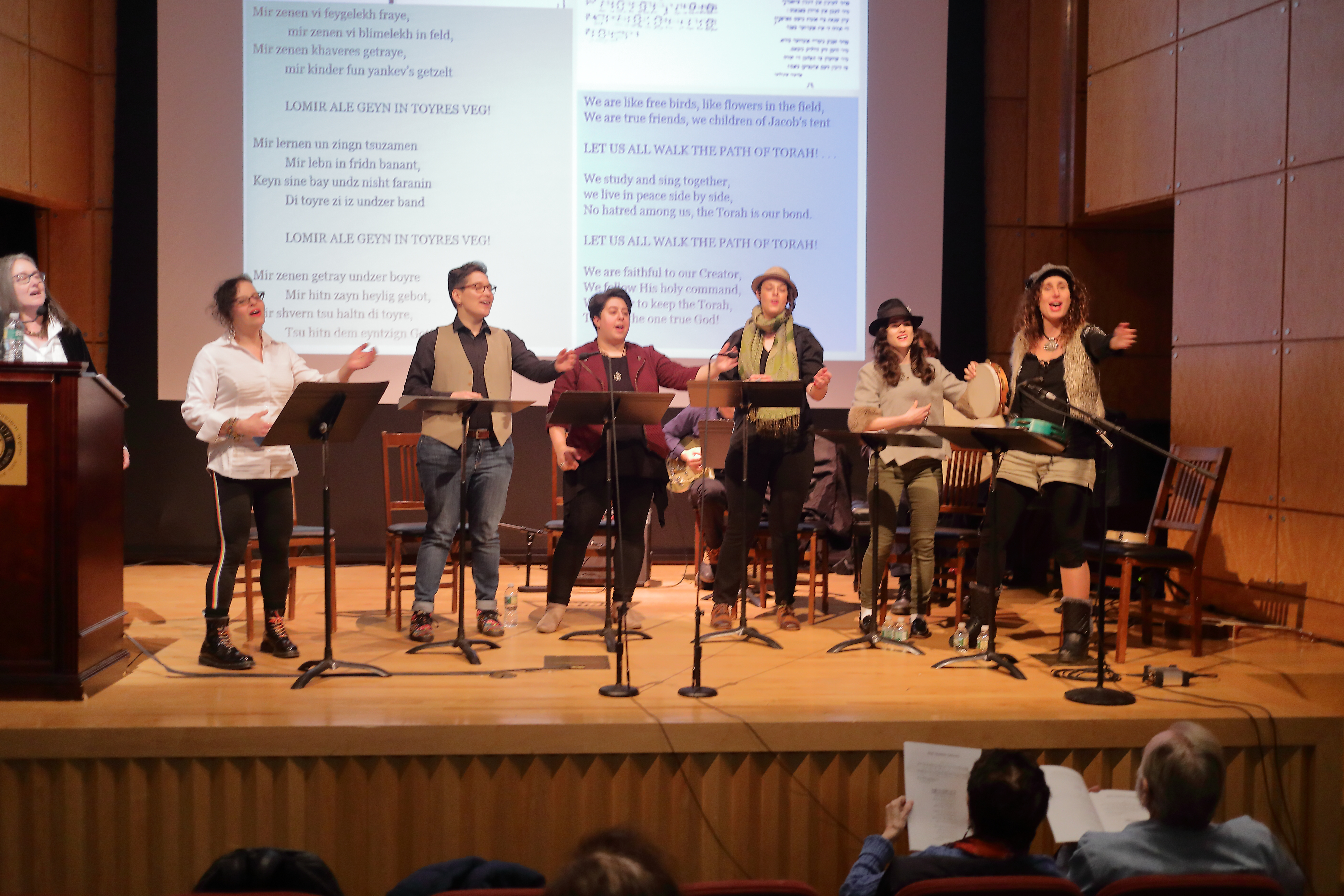
The choir on stage at YIVO, March 24, 2019. L-R: Naomi Seidman, Michelle Miller, Roni Mazal, Dainy Bernstein, Rivky Grossman, Batya Okunov, Basya Schechter.
Photo: Steve Beltzer.

Two weeks ago, Naomi Seidman wrote about the Bais Yaakov songbook that she found in the YIVO archives. That blog post includes video of the very first contemporary performance of the songs, arranged by Basya Schechter, at UPenn. Naomi and Basya continue to work on those songs and others, most recently at an Archive Transformed workshop in Boulder, Colorado.

On March 24, 2019, a group of Bais Yaakov graduates, myself included, performed the songs as part of an event at YIVO where Naomi delivered a lecture about the subject matter of her book, Sarah Schenirer and Bais Yaakov: A Revolution in the Name of Tradition.

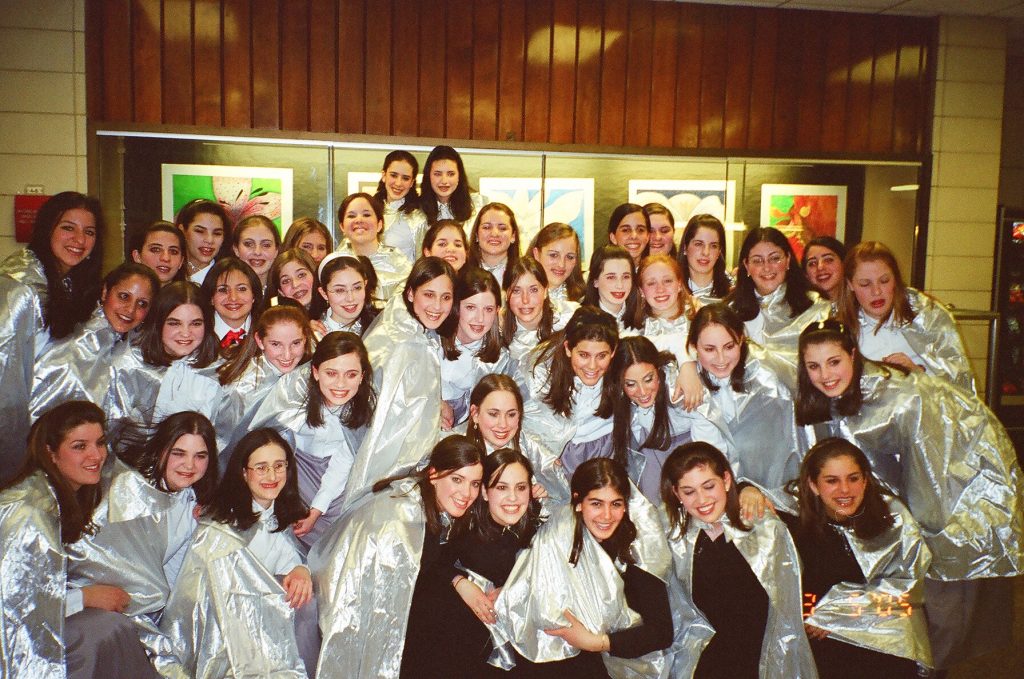
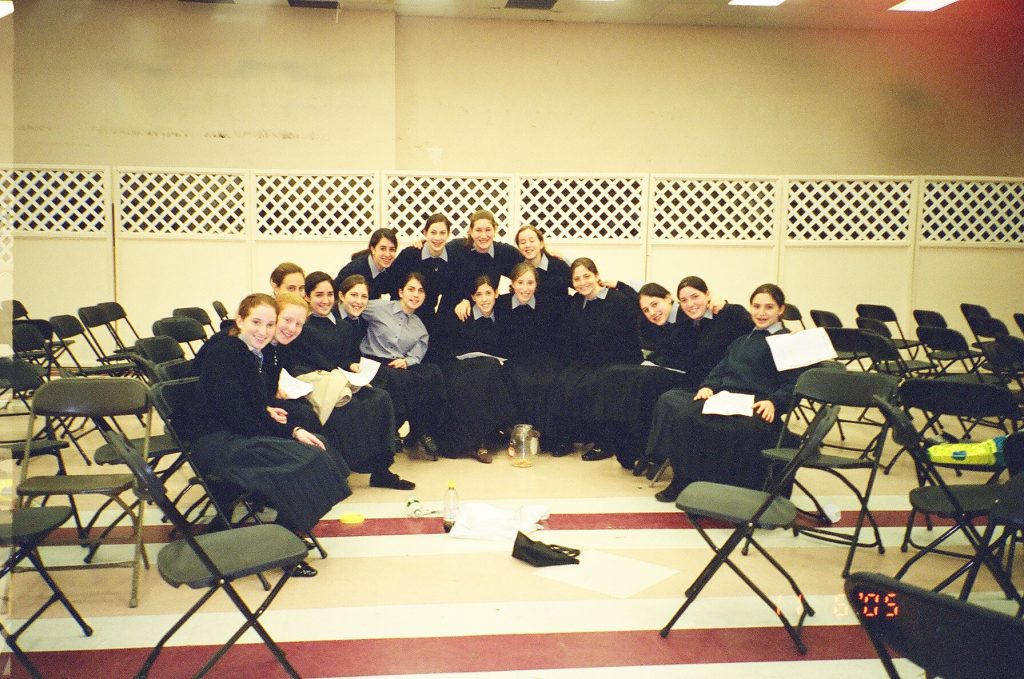
As Naomi explains in her lecture, plays – and extracurricular activities in general – are a major part of the Bais Yaakov experience. So when we all got together in Basya’s apartment a week before the event at YIVO to rehearse the songs, there was an air of familiarity to the activity for all of us. How many hours had we all spent staying late after school to practice for plays and choirs, for school shabbatons and Mishmeres and G.O. and chesed?

The choir from a play performed by students in Bais Yaakov High School (Brooklyn, NY), February 2005.
A group of students in Bais Yaakov High School (Brooklyn, NY) preparing for a performance. November 2005.
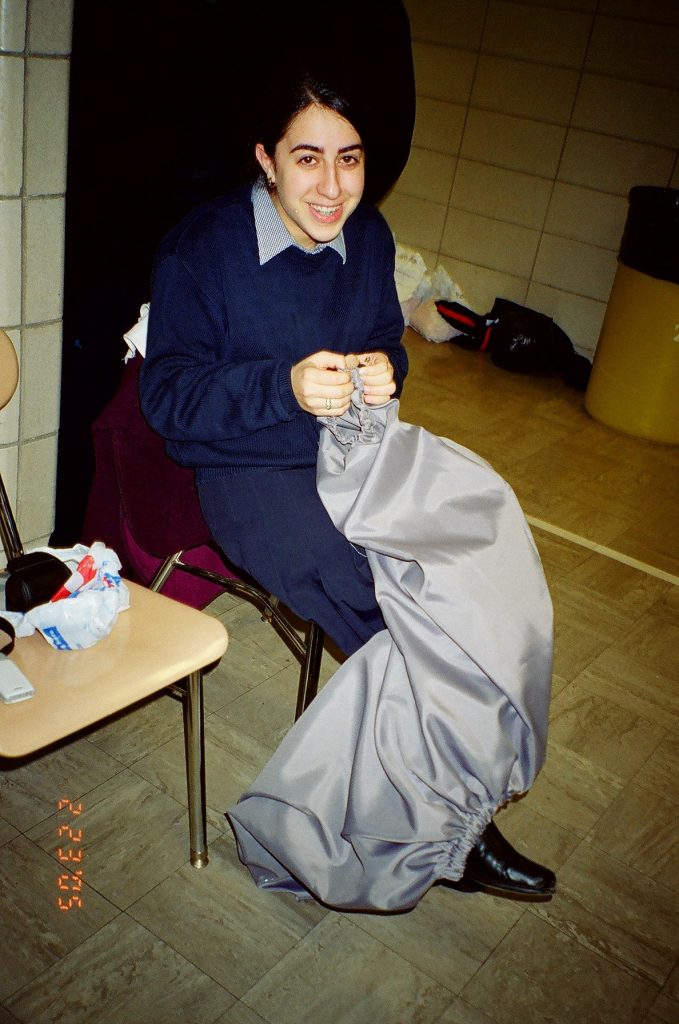
Dainy Bernstein, sewing a costume for the school play. Grade 11, Bais Yaakov High School (Brooklyn, NY), February 2005.

As we figured out the melody and harmony and arrangement for each song, it was work. And when we put it all together and sang each song, it was magic – it was like a kumzitz, those hours and hours we spent as Bais Yaakov students sitting on floors and at long tables, arms around each other’s shoulders, singing together. Adding motions was another level of nostalgia.

Of all the songs we sang on March 24, 2019, I had only heard one of them before. But it still felt like singing songs I had known my whole life – it’s not the melodies or the lyrics themselves that make that happen. It’s the ta’am, the feel and atmosphere of the songs as a whole. We may not have sung these songs that Bais Yaakov girls of interwar Europe sang, but we are part of the same Bais Yaakov movement, and this experience connected us across decades and oceans. 

You can clearly see the joy and fun we have performing on stage. This is a group of people I had met exactly one week before the performance, but that’s what a shared history can do – we became instant shvesters, connected by the Bais Yaakov history we shared, amplified by the songs.

You can also clearly see that none of us on the stage followed in the path our Bais Yaakov teachers and principals would have wanted. We are academics and performers, some of us parents and spouses – though perhaps not in the way our teachers would be proud of. Singing these songs was not pure unmitigated sweetness. 

Rivky Grossman reflects:

“I rarely sing traditional stuff. I haven’t immersed myself in anything frum or Bais Yaakov related in so long that at first it came with an almost full on resistance, like NO way am I doing this!

But I let the resistance pass, and I started to realize there’s a nostalgic sweetness. And inside of that sweetness, some calm entered in, and then there’s community, and through joining all of us together, that sweetness and calm and relatability expanded much more to allow room for the academic part, the emotional part, the traditional part – all rolled into one big curious and uniting force. We shared music and channeled our uniqueness from our present day beings.

Weird, silly, special, bittersweet. Lovely.”

The video below, recorded and posted by YIVO, includes Naomi’s lecture as well as the songs. The songs are at the following moments in the video:

Dainy Bernstein is a PhD Candidate at the CUNY Graduate Center. Their dissertation is tentatively titled Suffering, Sacrifice, Saints, and Survival: The Construction of a Jewish Past in American Haredi Children’s Literature and Education, 1980-2000